
My daughter has been really into Chicka Chicka Boom Boom lately. If you don’t know it, it’s a kids book about the letters of the alphabet trying to climb a coconut tree, which then tips over and dumps them all out. There’s a wonderful rhythm to the rhyming verse, and, so, it has been running through my head over the last few days, as these things do.
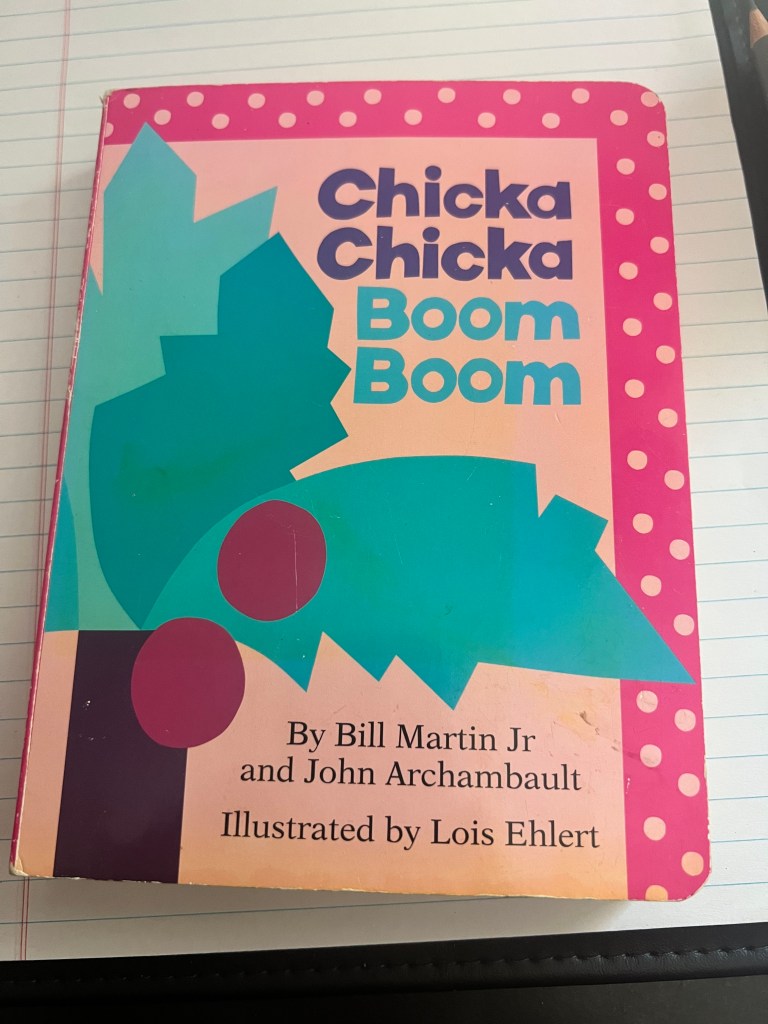

As I was out on a walk this morning, under a beautiful just-waning full moon, I found myself chanting the words to Chicka Chicka Boom Boom in time to my steps and thinking about the images of the mostly-lower case letters that run throughout the pages of the book. (A few “mamas and papas, uncles and aunts” do show up briefly as upper case letters to “hug their little dears and dust their pants” after they fall.)
Because they are characters, the letters move about non-linearly across the page—horizontally and vertically. Because they fall out of the tree they are shown in a pile—upside-down, sideways, backward, etc.. Because they get hurt, the letters get twisted and distorted (e.g., with a “stubbed toe”). This is one of the things that makes this book so great: It allows emerging readers to practice letter recognition in a way that requires their brains to bust out the tool of perceptual invariance.
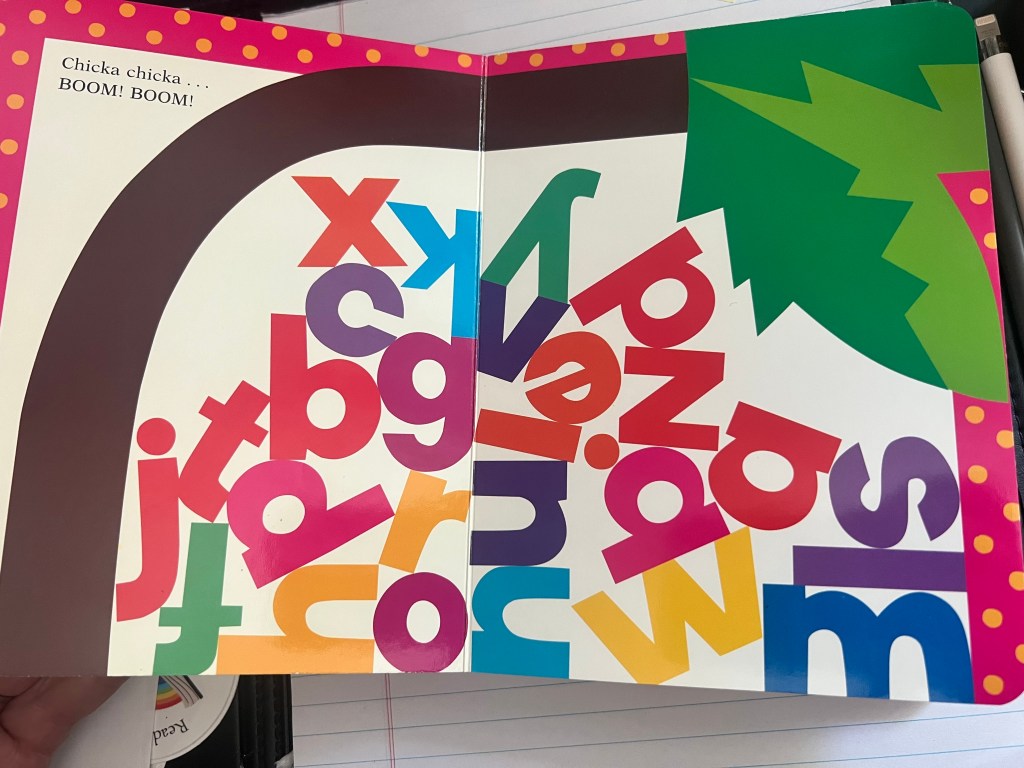
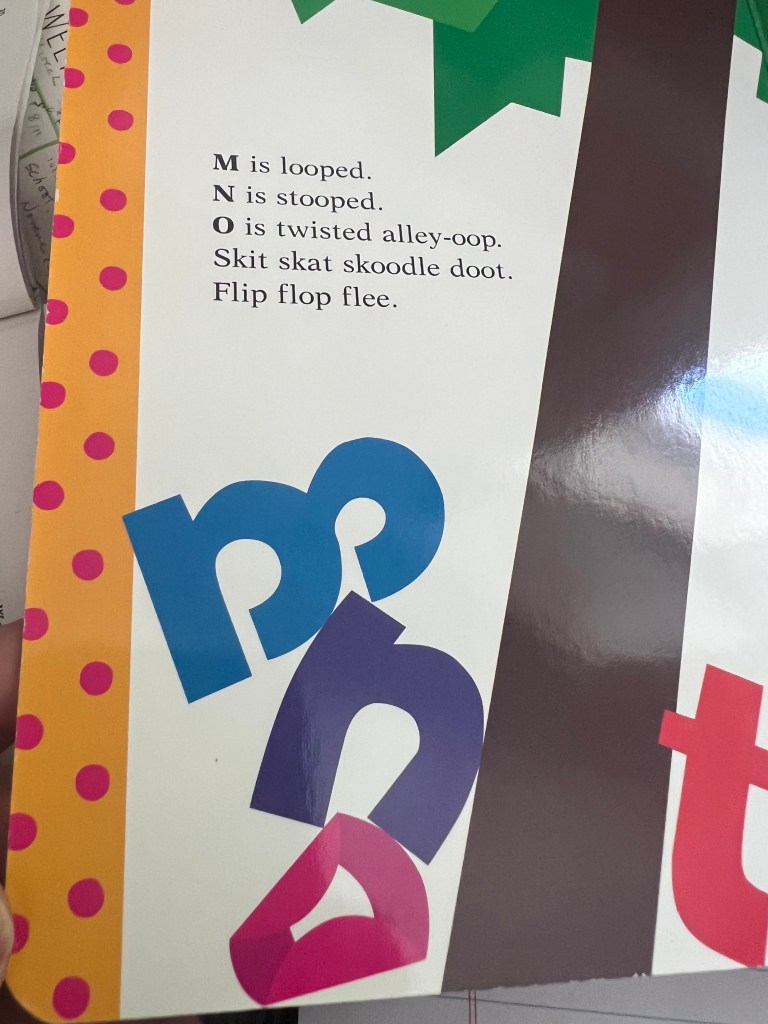
If we imagine our visual field as a screen, with each pixel connecting to a different neuron (a ridiculously simplified metaphor), we might imagine that reading could be as simple as memorizing different pixel/neuron patterns for the shapes of different words. But this isn’t how it works: the variety of locations, sizes, colors, fonts, and weights of letters we encounter is nearly endless, and so, as we become skilled readers, our brains must learn to identify something invariable about each letter—some essential characteristic—and correct for non-essential differences.
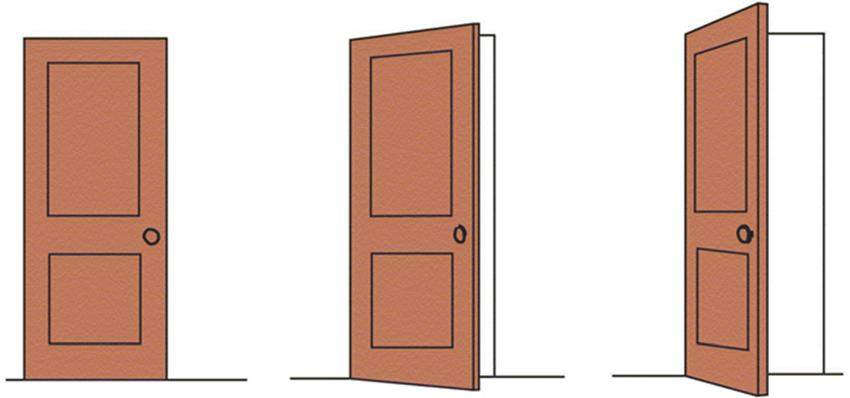
Perceptual invariance is a term neuroscientists and psychologists use to describe this ability to hold onto the essential, the fact that our experience and understanding of an object tend to remain consistent even when the sensory inputs for it vary. Consider, for example, the difference between looking at a rectangular object straight on and looking at it at an angle. The rectangle as seen from a distance comes to our sensory perception as a trapezoid, but our brain corrects it to a rectangle by taking into account our angle of perception.
Perceptual invariance doesn’t only account for changes in shape. Color (e.g., with varying light sources), location in our visual field as we move about to get a better view, various aspects of sound, and many other sensory inputs are all implicated and accounted for. How our brains do this does not seem to be settled science, but regardless of the mechanism, scientists have seen the phenomena at work in our brains as we learn to read.
As Stanislaus Dehaene notes in Reading and the Brain: The New Science of How We Read (Penguin 2009), “Reading poses a difficult perceptual problem. We must identify words regardless of how they appear, whether in print or handwritten, in upper- or lower-case, and regardless of their size.” (Dehaene, 18)
Whatever our brains do to maintain perceptual invariance for our experience of our environments, early readers must use to develop the skill of letter recognition and, later, word recognition.
The fact that our brains can be taught to differentiate between inessential differences and essential differences, pay attention to the former and effectively ignore the latter is honestly amazing. A skilled reader will have no problem differentiating between “eight” and “sight” while paying little attention to the difference between “eight” and “EIGHT.”
Early on, babies develop the ability to, for example, recognize important people regardless of slight changes in appearance, scent, location, etc. They develop the ability to identify the categories that our general nouns name, like “dog” and “house” and “person.” This development happens in most children without any explicit learning or teaching.
But with reading, the “capacity to attend to relevant details results from training. The same reader who immediately spots the difference between letters ‘e’ and ‘o,’ and the lack of difference between ‘a’ and ‘a,’ may not notice that the Hebraic letters “ת” and “ה” differ sharply, a fact that seems obvious to any Hebrew reader.” (Dehaene, 21)
One common metaphor used in the science of reading is that regions of our brain that evolved to handle certain tasks related to vision and sound have to be “recycled” when we learn to read.
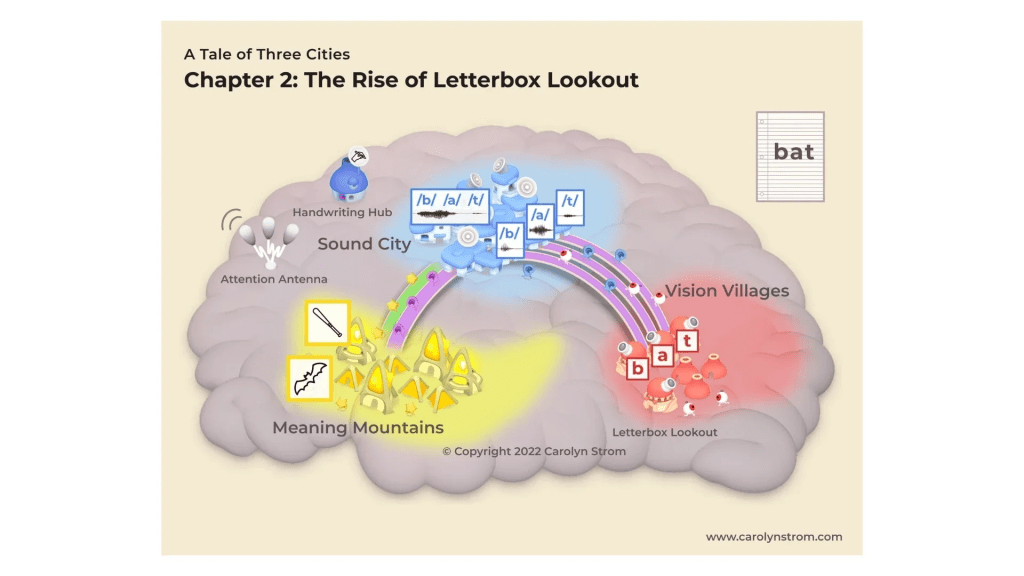
Through recent neuroimaging, scientists have been able to track the pathways of lexical input as the brains of expert readers make sense of them—to see, essentially, how we are repurposing the areas of our brains that evolved before writing to make sense of and use this code.
What they have found is that images of words flow from our eyes to the visual centers in the brain and are then “sorted into meaningful categories.” (Dehaene, 21) Words like “eight” and “sight” are initially processed similarly by the visual brain, later differentiated, and moved to the part of the brain responsible for meaning. Words like “eight” and “EIGHT,” however, start out as distinct in the visual brain. It is only later, when they have passed through more abstract letter detectors, that they are classified as having the same meaning. (22)

Through explicit instruction, practice, and error correction, the sight, sound, and meaning centers of our brains create pathways between and amongst themselves that can identify when a given visual input contains the essence of one of the letters of our alphabet. With more and more exposure to a variety of text styles, the pathways become stronger, our ability to differentiate even highly unfamiliar letters becomes stronger.
All this to say: reading is a lot of work. It doesn’t come naturally like learning to differentiate dogs from cats, snakes from cucumbers. Even the seemingly simple act of learning to recognize letters of a given alphabet requires many layers of pathways be built up in the emerging reader’s brain.
Whether the authors of Chicka Chicka Boom Boom understood this or not, I don’t know; it was certainly written before the most recent neuroscientific understandings about the mechanics of reading were developed. But we’ve understood that letter recognition is a foundational and distinct reading skill for generations.
And whatever their motivation, my daughter sure seems to delight in letting the images work their way into her brain. I have to imagine they’re having an impact on her ability to recognize the letter o, even when it is “twisted alley-oop.”
You don’t have to understand the neuroscience of reading to support your kids in developing literacy skills. I am certainly not a neuroscientist. But sometimes I think we forget that reading doesn’t come “naturally” in the same way spoken language does.1
Check out Chicka Chicka Boom Boom at your local library and get the verses stuck in your head so you, too, can be disgustingly adorable and sing them in unison in the car like my kids and I did today.
Or, if you’re feeling overwhelmed, reach out. I’d love to support you and your developing reader in any way I can.
1 Humans have not been reading and writing long enough for our brains to have adapted to it. They are marvelously plastic and adaptable organs, but for most of human history (not to mention pre-history), reading and writing was far from a necessity for survival that would result in an evolutionary adaptation.

 Joyful Literacy
Leave a comment